Legal Aid (UK) - Clio
Opening a new regulated market through workflow simplification and structured data modeling
Role
Product Designer, Platform Expansion, UK Market
Timeframe
2019–2021
Method
Field discovery with UK legal aid firms and practitioners; regulatory constraint mapping; structured data modelling; workflow prototyping and validation
Outcome
20% net-new regional sales pipeline
Role
Product Designer
Industry
SaaS · B2B
status
Live
Year
2022
Challenge
Role: Design Lead
Scope: End-to-end discovery → IA → UX → validation → delivery
Market: UK Legal Aid
Impact:
+26% MMR growth in UK
Opened 20% additional addressable market
Improved NPS
Launched at ClioCon
The Challenge
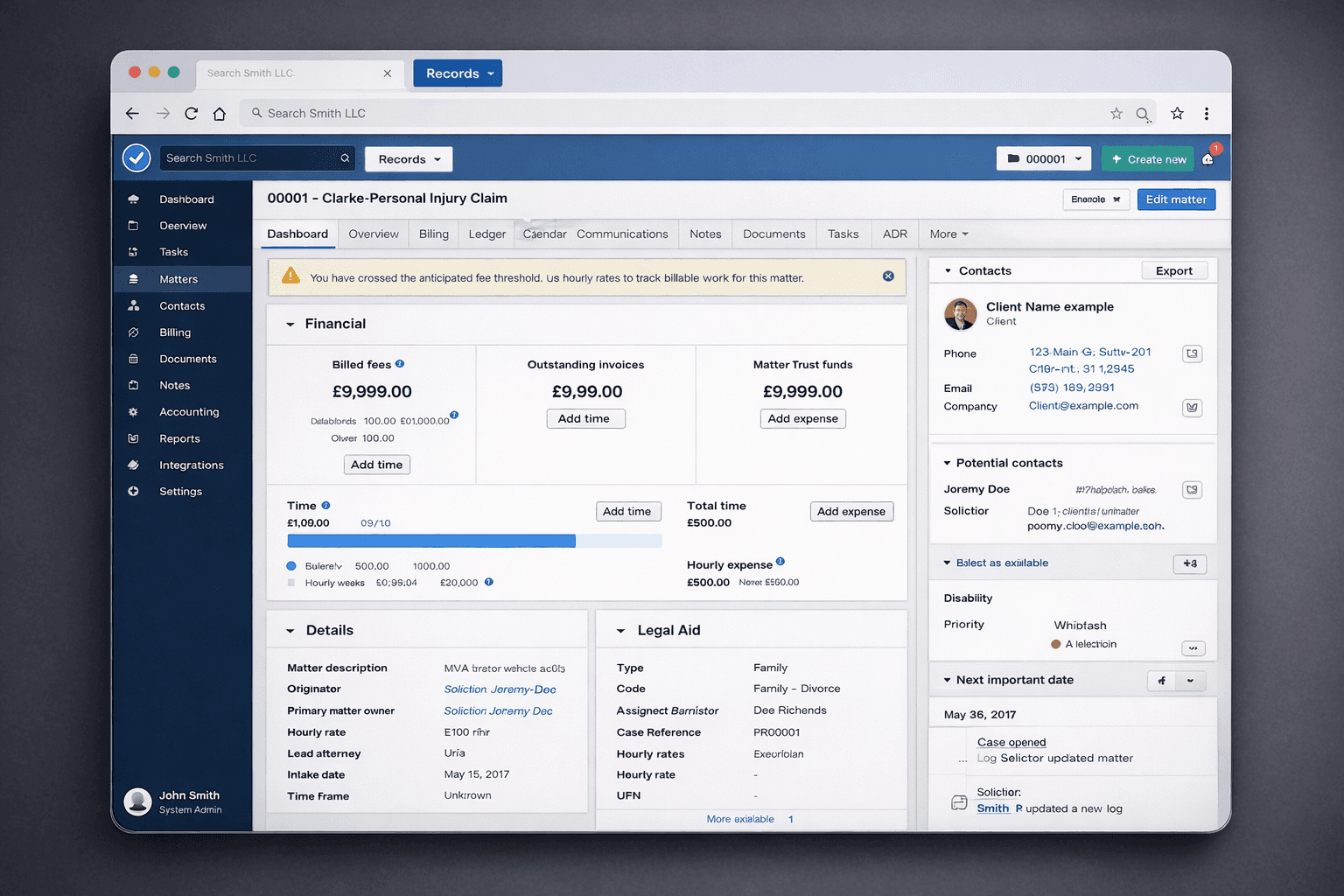
Clio could not properly support UK Legal Aid firms.
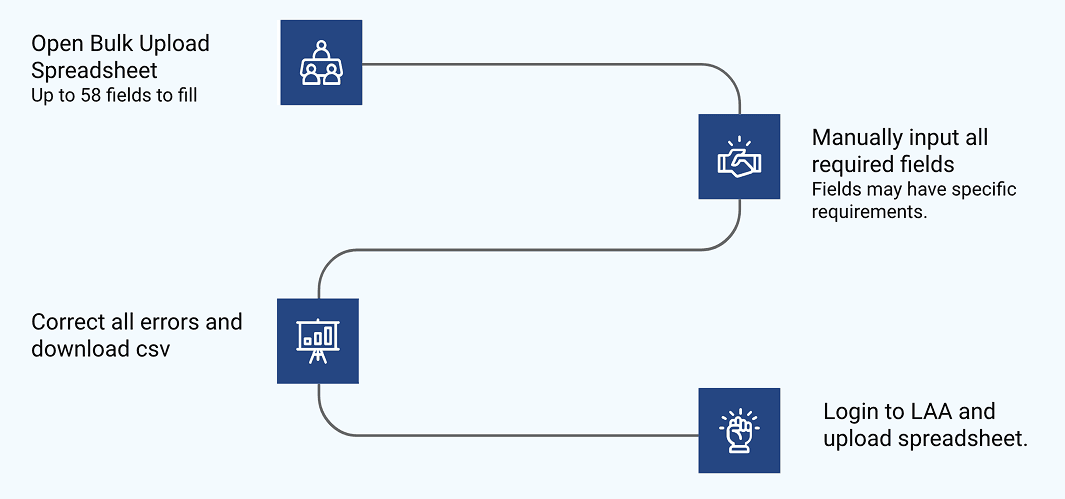
Firms were required to manually complete bulk spreadsheets with up to 58 fields, correct errors, and upload them directly to the Legal Aid Agency portal. There was no reliable way within Clio to capture required Legal Aid data or generate compliant reports.
This created:
Manual administrative burden
Error-prone submissions
Missed reimbursements
Lost sales opportunities in the UK market
Legal Aid became a consistent deal blocker and limited 20% of the UK addressable market.
My Role
As Design Lead, I was responsible for understanding the Legal Aid process end-to-end — from how firms currently worked to how we could embed compliant workflows directly into Clio.
This required balancing:
Legal accuracy
Complex rate structures
Structured reporting requirements
Usability for time-constrained legal professionals
Process
Discovery
I conducted qualitative research across multiple areas of UK law to understand variations in Legal Aid requirements.
Key findings:
Lawyers were performing highly manual administrative tasks themselves due to lack of error prevention
Cost structures varied significantly by practice area, region, activity type, and fee scheme
Errors in bulk uploads created downstream rework and reimbursement risk
Competitive analysis showed partial solutions in the market, but competitors struggled with error prevention and accurate cost modeling.
This presented an opportunity to go to market with a more complete and reliable solution.
Information Architecture & Data Modeling
The complexity of Legal Aid lay in its rate matrix. The documentation provided by the Legal Aid Agency exceeded 5,000 lines and had no structured format.
I worked with engineering to:
Convert this documentation into a structured JSON data model
Define relationships between practice area, activity type, region, category of law, and fee scheme
Map required fields dynamically based on area of law
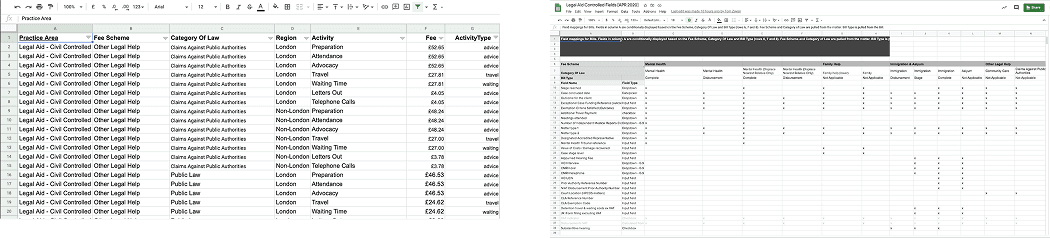
This enabled us to surface the correct inputs programmatically rather than relying on static forms. Card sorting workshops with CS, design, and engineering helped define a scalable taxonomy that supported iterative expansion.
UX Strategy
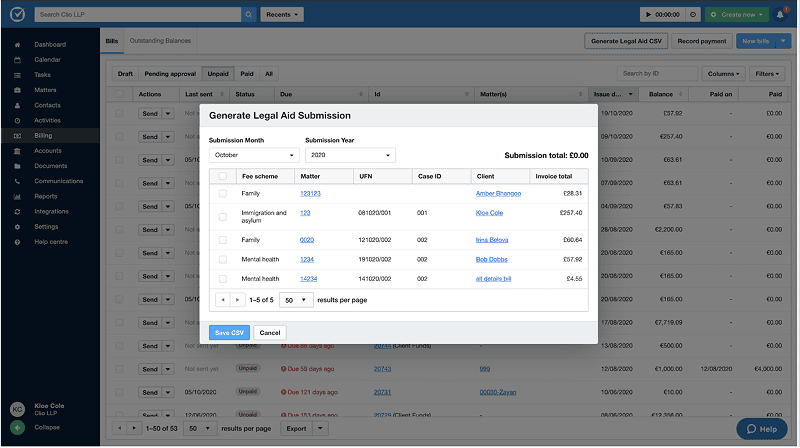
The goal was not visual redesign, it was error prevention and clarity.
I redesigned the workflow to:
Surface only relevant fields per case type
Reduce redundant input
Generate compliant exports directly within Clio
Provide visibility into submission readiness
This shifted the process from spreadsheet-based correction to system-guided completion.
Outcome
Validation
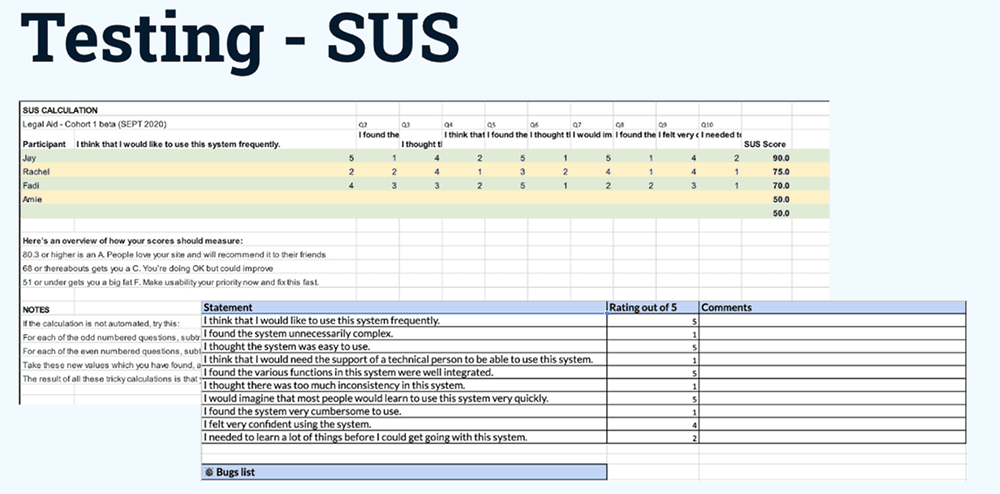
I created a full interactive prototype covering core Legal Aid tasks. We conducted usability testing using the System Usability Scale (SUS). Results showed improved usability confidence and reduced perceived complexity compared to the legacy approach. Participants reported greater clarity and stronger confidence in submission accuracy.
Development & Delivery
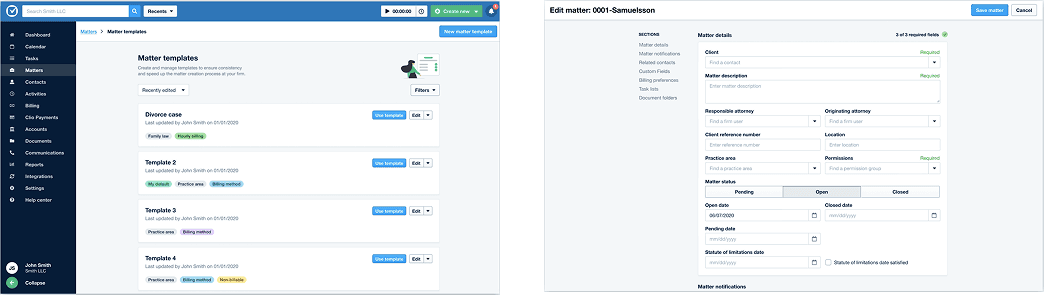
I collaborated closely with engineering in 2-week sprints over 4 months. The work required precise mapping between UX fields and backend rate logic.
We prioritized:
Accuracy over feature breadth
Correct export formatting
Incremental rollout to mitigate regulatory risk
Post-MVP, I revisited UI improvements to further refine clarity and reduce friction.
Rollout
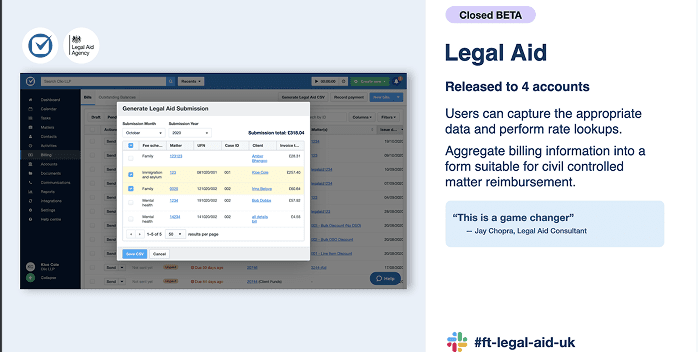
The feature launched in a closed beta to 4 accounts to validate real-world usage. Our primary KPI was export generation frequency and error rate. Accounts successfully generated and uploaded compliant spreadsheets to the Legal Aid portal. We then expanded beta access before broader release.
Results
UK MMR increased by 26%
Opened 20% of previously inaccessible market
Increased NPS
Publicly announced at ClioCon
Legal Aid moved from a deal blocker to a strategic UK growth lever.
Reflection
This project strengthened my ability to:
Translate regulatory documentation into structured product logic
Balance legal compliance with usability
Lead cross-functional collaboration in complex domains
Deliver measurable commercial impact
While not a multi-org transformation project, it demonstrated how structured discovery and disciplined UX architecture can unlock new markets.
Legal Aid (UK) - Clio
Opening a new regulated market through workflow simplification and structured data modeling
Role
Product Designer, Platform Expansion, UK Market
Timeframe
2019–2021
Method
Field discovery with UK legal aid firms and practitioners; regulatory constraint mapping; structured data modelling; workflow prototyping and validation
Outcome
20% net-new regional sales pipeline
Role
Product Designer
Industry
SaaS · B2B
status
Live
Year
2022
Challenge
Role: Design Lead
Scope: End-to-end discovery → IA → UX → validation → delivery
Market: UK Legal Aid
Impact:
+26% MMR growth in UK
Opened 20% additional addressable market
Improved NPS
Launched at ClioCon
The Challenge
Clio could not properly support UK Legal Aid firms.
Firms were required to manually complete bulk spreadsheets with up to 58 fields, correct errors, and upload them directly to the Legal Aid Agency portal. There was no reliable way within Clio to capture required Legal Aid data or generate compliant reports.
This created:
Manual administrative burden
Error-prone submissions
Missed reimbursements
Lost sales opportunities in the UK market
Legal Aid became a consistent deal blocker and limited 20% of the UK addressable market.
My Role
As Design Lead, I was responsible for understanding the Legal Aid process end-to-end — from how firms currently worked to how we could embed compliant workflows directly into Clio.
This required balancing:
Legal accuracy
Complex rate structures
Structured reporting requirements
Usability for time-constrained legal professionals
Process
Discovery
I conducted qualitative research across multiple areas of UK law to understand variations in Legal Aid requirements.
Key findings:
Lawyers were performing highly manual administrative tasks themselves due to lack of error prevention
Cost structures varied significantly by practice area, region, activity type, and fee scheme
Errors in bulk uploads created downstream rework and reimbursement risk
Competitive analysis showed partial solutions in the market, but competitors struggled with error prevention and accurate cost modeling.
This presented an opportunity to go to market with a more complete and reliable solution.
Information Architecture & Data Modeling
The complexity of Legal Aid lay in its rate matrix. The documentation provided by the Legal Aid Agency exceeded 5,000 lines and had no structured format.
I worked with engineering to:
Convert this documentation into a structured JSON data model
Define relationships between practice area, activity type, region, category of law, and fee scheme
Map required fields dynamically based on area of law
This enabled us to surface the correct inputs programmatically rather than relying on static forms. Card sorting workshops with CS, design, and engineering helped define a scalable taxonomy that supported iterative expansion.
UX Strategy
The goal was not visual redesign, it was error prevention and clarity.
I redesigned the workflow to:
Surface only relevant fields per case type
Reduce redundant input
Generate compliant exports directly within Clio
Provide visibility into submission readiness
This shifted the process from spreadsheet-based correction to system-guided completion.
Outcome
Validation
I created a full interactive prototype covering core Legal Aid tasks. We conducted usability testing using the System Usability Scale (SUS). Results showed improved usability confidence and reduced perceived complexity compared to the legacy approach. Participants reported greater clarity and stronger confidence in submission accuracy.
Development & Delivery
I collaborated closely with engineering in 2-week sprints over 4 months. The work required precise mapping between UX fields and backend rate logic.
We prioritized:
Accuracy over feature breadth
Correct export formatting
Incremental rollout to mitigate regulatory risk
Post-MVP, I revisited UI improvements to further refine clarity and reduce friction.
Rollout
The feature launched in a closed beta to 4 accounts to validate real-world usage. Our primary KPI was export generation frequency and error rate. Accounts successfully generated and uploaded compliant spreadsheets to the Legal Aid portal. We then expanded beta access before broader release.
Results
UK MMR increased by 26%
Opened 20% of previously inaccessible market
Increased NPS
Publicly announced at ClioCon
Legal Aid moved from a deal blocker to a strategic UK growth lever.
Reflection
This project strengthened my ability to:
Translate regulatory documentation into structured product logic
Balance legal compliance with usability
Lead cross-functional collaboration in complex domains
Deliver measurable commercial impact
While not a multi-org transformation project, it demonstrated how structured discovery and disciplined UX architecture can unlock new markets.